age calculator
How to create an age calculator using Excel
Now that you know how to make an age formula in Excel, you can build a custom age calculator, for example this one:https://onedrive.live.com/embed?c
The image above is an embedded Excel Online sheet, so do not hesitate to input your birthdate in the corresponding cell, and you will discover your age in just a few seconds.
Calculators use these formulas to calculate age based on the date of birth in cell A3 as well as today's date.
-
Formula in B5 calculates age in years, months, and days:
=DATEDIF(B2,TODAY(),"Y") & " Years, " & DATEDIF(B2,TODAY(),"YM") & " Months, " & DATEDIF(B2,TODAY(),"MD") & " Days" -
Formula in B6 calculates age in months:
=DATEDIF($B$3,TODAY(),"m") -
Formula in B7 calculates age in days:
=DATEDIF($B$3,TODAY(),"d")
If you're familiar using Excel Form controls, you have the option to calculate age on a particular date as illustrated in the screenshot below:
In order to do this, add two options buttons ( Developer tab > Insert > Form controls > Option Button), and link them to a cell. Also, create an IF/DATEDIF formula to get age as of today's date or at the time specified by the user.
The formula operates according to the following reasoning:
-
If the Today's date option box is selected, value 1 appears in the linked cell (I5 in this example), and the age formula calculates based on the today date:
IF($I$5=1, DATEDIF($B$3,TODAY(),"Y") & " Years, " & DATEDIF($B$3,TODAY(), "YM") & " Months, " & DATEDIF($B$3, TODAY(), "MD") & " Days") -
If the Specific date option button is selected AND a date is entered in cell B7, age is calculated at the specified date:
IF(ISNUMBER($B$7), DATEDIF($B$3, $B$7,"Y") & " Years, " & DATEDIF($B$3, $B$7,"YM") & " Months, " & DATEDIF($B$3, $B$7,"MD") & " Days", ""))
Finally, nest the above functions in a way, and you'll get the entire age calculator (in the form of B9):
=IF($I$5=1, DATEDIF($B$3, TODAY(), "Y") & " Years, " & DATEDIF($B$3, TODAY(), "YM") & " Months, " & DATEDIF($B$3, TODAY(), "MD") & " Days", IF(ISNUMBER($B$7), DATEDIF($B$3, $B$7,"Y") & " Years, " & DATEDIF($B$3, $B$7,"YM") & " Months, " & DATEDIF($B$3, $B$7,"MD") & " Days", ""))
The formulas found in B10 and B11 work with an identical logic. Of course, they are considerably simpler, as they both contain only one DATEDIF function that returns age as the number of complete months or days, respectively.
For more information I encourage you to install the Excel Age Calculator and investigate the formulas within cells B9:B11.
Download Age Calcqulator for Excel
Ready-to-use age calculator for Excel
Users of our Ultimate Suite don't have to make an own age calculator in Excel - it's only two clicks away:
-
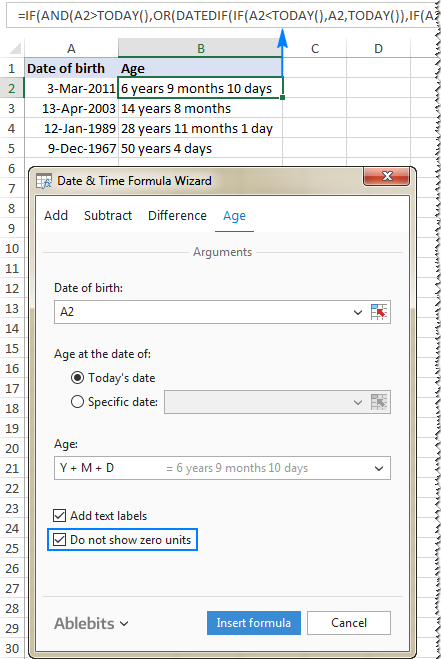
Select a cell that you would like to add an age formula, go to the Ablebits Tools tab, then the Date & Time group, and then click the Date & Time Wizard button.
- It will begin the Date & Time Wizard will startand then you can go direct to page for age. tab.
-
On the
Age
On the tab, you will find 3 items to be specified:
- Birth date data as an individual cell reference or date in the mm/dd/yyyy format.
- Age at the current date or an exact date.
- Decide whether to calculate age in terms of days, months or years, or choose the precise age.
- Click the Insert formula button.
Done!
The formula is placed in the cell you have selected, and you double-click onto the handle for fill to paste the formula down the column.
If you've observed, the formula created in the Excel age calculator is more complex than the ones we've discussed so far but it does take into account singular and plural of time units like "day" and "days".
If you'd like to dispose of units that are zero like "0 days", select the Don't display zero units checkbox:
If you're interested to test the age calculator as well as to discover more time-saving extensions for Excel, you are welcome to download a trial Version of our Ultimate Suite. If you are impressed by the software and decide to get a license, don't miss this great deal exclusively for blog readers.
How to identify certain types of ages (under or above a particular age)
In some instances it is possible to not simply calculate age in Excel but also highlight cells that contain age ranges that are below or over a particular age.
If your age calculation formula yields the total number of years it is possible to design a regular conditional formatting rule that is based on a simple formula similar to these:
- To draw attention to ages that are equal to or more than 18:
- To highlight ages under 18: =$C2<18
C2 is the highest cell of the column called Age (not even including the header).
But what happens if the formula has age in years and months, or in years, months and days? In this situation you'll have to develop a rule basing it on a DATEDIF formula that calculates age from date of birth in years.
Supposing the birthdates are in column B starting with row 2, the formulas are:
-
To highlight ages under 18 (yellow):
=DATEDIF($B2, TODAY(),"Y")<18 -
To highlight ages between 18 and 65 (green):
=AND(DATEDIF($B2, TODAY(),"Y")>=18, DATEDIF($B2, TODAY(),"Y")<=65) -
To show Ages that are over 65 (blue):
=DATEDIF($B2 (TODAY (),"Y")>65
To create rules based upon the above formulas, select the rows, or the cells which you would like to highlight, go to the Home tab, then Styles group, then click Conditional Formatting > New Rule... > Create a formula to identify which cells you should format.
The complete steps can be found in this article: how to create an automatic conditional formatting rule that is based on formula.
This is the method you use to calculate age using Excel. I hope that the formulas were easy to understand and that you'll give them an attempt in your worksheets. Thank you for reading , and hope to see you on our blog next week!
Comments
Post a Comment